


Introduction
Double gauze cotton bedding feels completely different from regular cotton. While standard cotton is smooth and dense, double gauze is lightweight, airy, and softly crinkled—often compared to clouds or cotton balls.
Its secret is the structure: two thin layers of cotton gauze loosely woven and tacked together, making it breathable, soft, and relaxed compared to percale or sateen. Unlike crisp, formal sheets, double gauze cotton bedding grows softer with every wash, ideal for sensitive skin, warm sleepers, or anyone who prefers gentle, cozy bedding.
This guide explores six key differences between double gauze and regular cotton: structure, texture, breathability, durability, temperature regulation, and value, helping you choose the perfect bedding for your needs.
What Is Double Gauze Cotton Bedding, and How Is It Constructed?
Double gauze cotton bedding stands out for its unique two-layer design. Unlike regular cotton sheets woven from a single layer—whether percale, sateen, or plain weave—double gauze combines two thin cotton gauze layers, stitched together at intervals. These tiny tacking stitches keep the layers aligned while creating a small air gap for breathability.
Gauze itself is lightweight and loosely woven, often used in baby swaddles or summer clothing for its softness and airflow. When layered and tacked, the fabric becomes thicker than single gauze but remains airy and light. The tacking stitches, spaced roughly every 2 cm (≈1 inch), create a subtle quilted texture.
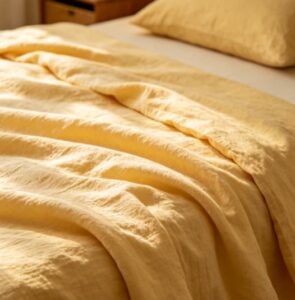
Visually, double gauze cotton bedding appears gently crinkled, softer than linen but less stiff. It drapes naturally, hugs the body without clinging, and produces a soft rustle rather than the crisp snap of percale or the slick slide of sateen. The fabric moves and breathes with you, offering a comfort that feels almost invisible—like a well-worn sweatshirt.
Surface Texture and Immediate Touch: Smooth vs. Softly Crinkled
Texture is the most noticeable difference between double gauze cotton bedding and regular cotton. Percale feels crisp and flat, while sateen is silky and high-luster. Double gauze, by contrast, has an uneven, softly crinkled surface, with micro‑bumps from the gauze weave and small dimples from the tacking stitches.
Against the skin, it feels airy, cloudlike, and pillowy, soft yet light, never slippery or clingy. Unlike smooth sheets, it moves easily with your body and stays comfortably in place.
This texture also affects perception: smooth sheets suggest precision and formality, while double gauze cotton bedding conveys relaxation and ease. Functional studies show that textured surfaces reduce direct skin contact, allowing better airflow and making the fabric feel cooler—an advantage for hot sleepers or humid climates.
Breathability and Airflow: Why Double Gauze Breathes Better
Double gauze cotton bedding excels in breathability, thanks to its two-layer construction. Each lightweight gauze layer has a loose, open weave, allowing air to pass through the first layer, circulate in the gap between layers, and exit through the second. This continuous airflow prevents heat and moisture from becoming trapped against the skin.
Compared to regular cotton:
- Percale is moderately breathable due to its plain weave.
- Satin is less breathable because the floating weave packs yarns tightly.
- High thread count sheets may block airflow entirely, reducing comfort.
The two-layer design also aids thermal regulation. As body temperature fluctuates during the night, double gauze acts as a buffer—keeping you warm when it’s cool and preventing overheating when it’s warm. This makes it suitable for year-round use.
In humid environments, breathability is even more important. Double gauze allows moisture to evaporate quickly, keeping your sleeping environment dry and comfortable.
Weight and Draping: Lightness Without Flimsiness
Double gauze cotton bedding is exceptionally light yet structured. Each layer uses fine yarns, and the open weave reduces overall fabric weight.
Benefits of its lightness and drape:
- Conforms gently to your body without restricting movement.
- Reduces pulling, bunching, or shifting during sleep.
- Maintains enough body to feel substantial, avoiding a flimsy sensation.
- Drifts in soft, organic curves rather than lying rigid and flat.
This relaxed draping creates a casual, comfortable aesthetic. If you prefer structured, crisp bedding, double gauze may feel too informal—but for a lived-in, cozy look, it’s ideal.
How It Feels During Sleep: Movement, Temperature, and Skin Sensitivity
Sleeping on double gauze cotton bedding is noticeably different from standard cotton due to its texture, breathability, and subtle elasticity. Key benefits include:
- Reduced clinging – Textured surface reduces skin contact, preventing the sticky feeling that smooth fabrics like sateen can produce.
- Temperature comfort – Excellent airflow avoids heat buildup, keeping sleepers comfortable without active cooling or warming.
- Flexible movement – The two-layer construction adds gentle stretch, allowing duvet covers and sheets to shift naturally with your body, reducing tangling and bunching.
- Gentle on sensitive skin – Fine yarns and a loose weave create a low-friction surface. Many double gauze products meet OEKO-TEX Class I standards, suitable for infants or people with eczema or other sensitivities.
Overall, double gauze provides a comfortable, breathable, and skin-friendly sleep experience that standard cotton often cannot match.
Does It Pill? Durability and Long‑Term Wear
Durability of double gauze cotton bedding depends heavily on fiber quality and weave density. High-quality double gauze, made from fine long-staple cotton and woven densely, resists pilling and maintains its shape through repeated washing. Lower-quality versions, often made with short-staple cotton or low-density construction, may pill over time, especially with friction during use or washing.
Lower-density double gauze can appear sparse, prone to deformation, and even slightly transparent. Premium double gauze maintains structure without losing breathability. In comparison, percale and sateen made from long-staple cotton are generally durable, while low-thread-count or short-staple cotton sheets may pill quickly. The key takeaway: check fiber composition and weave density when selecting double gauze bedding—quality makes all the difference.
Washing and Care: Shrinkage and Softer Over Time
Double gauze cotton bedding needs gentle handling, but care is straightforward. Shrinkage is common during the first wash due to the loose weave, so pre-washing is strongly recommended, especially if you bought bedding to fit a specific mattress. Pre-washing also removes any manufacturing residues and begins the softening process.
Over time, double gauze naturally becomes softer and more pliable, enhancing its crinkled texture and relaxed drape. Unlike some regular cotton that may stiffen with repeated washes, double gauze improves with age. Mild detergent, cool or warm water, and gentle cycles are ideal. Avoid bleach and fabric softeners, and dry on low heat or line dry. Washing with delicate fabrics or items with zippers should be avoided to prevent snagging.
The “Gets Better with Age” Factor
One of the most distinctive features of double gauze cotton bedding is that it improves with use. With each wash, the fibers relax, the layers settle into a more flexible configuration, and the fabric develops a cushioned, soft feel. The crinkle becomes more uniform, and the drape more fluid.
Unlike many regular cotton sheets that remain the same or gradually degrade, double gauze feels better the more it is used. This “lived-in” quality is especially appealing for those who appreciate comfort that grows with time. It is part of the fabric’s charm—soft, cozy, and enduring.
Comparing Double Gauze to Regular Cotton Bedding Types
Here is a direct comparison chart summarizing how double gaze coton literie stacks up against the most common regular cotton bedding types.
| Fonctionnalité | Double gaze de coton | Percale | Satin | Muslin / Single Gauze |
|---|---|---|---|---|
| Construction | Two gauze layers tacked together | Single layer, plain weave | Single layer, floating weave | Single layer, loose open weave |
| Poids | Very light | Léger à moyen | Moyen à lourd | Extremely light |
| Douceur | Pillowy, cloudlike | Crisp, cool, smooth | Silky, slick, smooth | Soft, delicate |
| Respirabilité | Excellent | Bon | Modéré | Excellent |
| Texture | Softly crinkled, irregular | Smooth, flat, matte | Smooth, shiny, slippery | Smooth but loose |
| Durabilité | Moderate to high (depends on density) | Haut | Haut | Faible |
| Heat regulation | Chaud en hiver, frais en été | Cool in summer | Warm in winter | Cool in summer |
| Maintenance | Shrinks first wash; becomes softer over time | Low maintenance | Low maintenance | High maintenance (very delicate) |
| Meilleur pour | All‑year use, sensitive skin, hot sleepers | Hot sleepers, warm climates | Cold sleepers, cool climates | Summer, travel, babies |
The chart shows that double gaze coton literie occupies a unique position. It matches muslin’s breathability but with greater durability. It offers more softness than percale while maintaining better airflow than sateen. It is not better than all regular cotton bedding in every category—percale still wins on crispness, and sateen wins on smoothness—but for the specific combination of softness, breathability, and all‑season comfort, double gauze performs exceptionally well.
When Double Gauze Is the Right Choice (and When It’s Not)
Double gauze cotton bedding is not for everyone. Knowing when it fits your needs and when it doesn‘t will help you decide.
Choose double gauze if:
-
You have sensitive skin or experience irritation from smooth or rough fabrics.
-
You sleep warm or experience night sweats and need maximum breathability.
-
You prefer bedding that feels cozy and lived‑in rather than crisp and formal.
-
You are willing to accept a naturally crinkled appearance without ironing.
-
You appreciate fabric that becomes softer and more comfortable with age.
-
You like very lightweight bedding that moves with you during sleep.
Avoid double gauze if:
-
You prefer bedding that stays smooth and wrinkle‑free without ironing.
-
You want a structured, crisp, hotel‑style look for your bed.
-
You prioritize extreme durability and expect the fabric to remain unchanged for many years.
-
You live in a very cold climate and need heavy, insulating bedding for warmth.
-
You prefer heavy sheets and quilts with significant weight.
For many people, the answer falls somewhere in the middle. You might choose double gauze for summer use and percale or sateen for winter. Or, you might keep a double gauze duvet cover on the bed year‑round, rotating quilt weights seasonally. There is no requirement to commit exclusively to one fabric.
Making the Switch — What to Expect on Your First Night
If you have only ever slept on regular cotton bedding, your first night with double gaze coton literie will feel unusual. The sheets will not feel cool and crisp the way fresh percale does. They will not feel silky like sateen. They will feel soft, light, and almost insulating—warm without being heavy.
When you first slip into a double gauze duvet cover, you may notice the lack of resistance. The fabric conforms to your body instead of lying flat on top of it. As you turn over during the night, you may notice that the duvet cover does not twist or tangle. As morning approaches, you may notice that you did not wake up feeling overheated, even though you remained under the covers all night.
The crinkled appearance may take some getting used to. If you are accustomed to making your bed with tight, smooth sheets, double gauze will not look the same. The crinkles and folds are part of the charm, not flaws to be ironed out. After a few weeks, you will likely stop noticing the crinkles and start appreciating the comfort. Many double gauze converts report that they cannot go back to regular cotton. The fabric is just too comfortable, too breathable, and too easy to live with.
Summary of Key Differences
To summarize, double gaze coton literie differs from regular cotton bedding in five key ways:
-
Construction. Double gauze has two layers; regular cotton has one layer.
-
Texture. Double gauze is softly crinkled and pillowy; regular cotton is smooth and flat.
-
Breathability. Double gauze is more breathable than almost any regular cotton weave.
-
Weight. Double gauze is lighter than percale or sateen of comparable size.
-
Aging. Double gauze becomes softer with each wash; regular cotton generally remains stable or slowly degrades.
No single fabric is objectively the best. The right choice depends on your personal preferences, your sleeping temperature, your skin sensitivity, and your aesthetic tastes. What is true for everyone is this: if you have never tried double gauze, you are missing out on a sleep experience that is fundamentally different from what regular cotton offers. It may not replace your favorite percale sheets, but it might become your new favorite for nights when you want comfort without compromise.
FAQ
Q1: Is double gauze cotton bedding more expensive than regular cotton?
Yes, high-quality double gauze is usually more expensive than basic percale or sateen. Its two-layer construction and more specialized manufacturing process contribute to the higher cost. However, more affordable double gauze options are also available on the market.
Q2: Does double gauze cotton bedding wrinkle easily?
It does not wrinkle in the traditional sense. Instead, it is designed with a naturally soft crinkled texture rather than sharp creases. This texture is permanent and does not require ironing.
Q3: Can people with sensitive skin use double gauze cotton bedding?
Yes. Double gauze is commonly recommended for people with eczema, allergies, or generally sensitive skin. Many products are also OEKO-TEX certified for added safety assurance.
Q4: How often should I wash double gauze cotton bedding?
Wash it as often as standard bedding—typically every one to two weeks under normal use. Use a mild detergent, cool or warm water, and a gentle cycle. Avoid fabric softeners and high heat to preserve fabric quality.
Q5: Will double gauze cotton bedding keep me cool in summer?
Yes. Its excellent breathability makes it well-suited for summer use. However, on extremely hot nights without air conditioning, a single gauze or muslin sheet may feel even lighter and cooler.
Conclusion
Double gauze cotton bedding is a soft, breathable, and lightweight alternative to regular cotton. Unlike percale or sateen, it feels airy, gentle, and naturally crinkled, becoming even softer with each wash.
Ideal for sensitive skin, hot sleepers, or anyone who prefers a relaxed, cozy bedding style, double gauze offers a noticeably different sleep experience. The first night may feel unusual, but many users quickly appreciate its comfort, breathability, and softness.
Try double gaze coton literie today—available in multiple colors, weights, and OEKO-TEX certified options. Request a sample or contact our team for wholesale inquiries.